









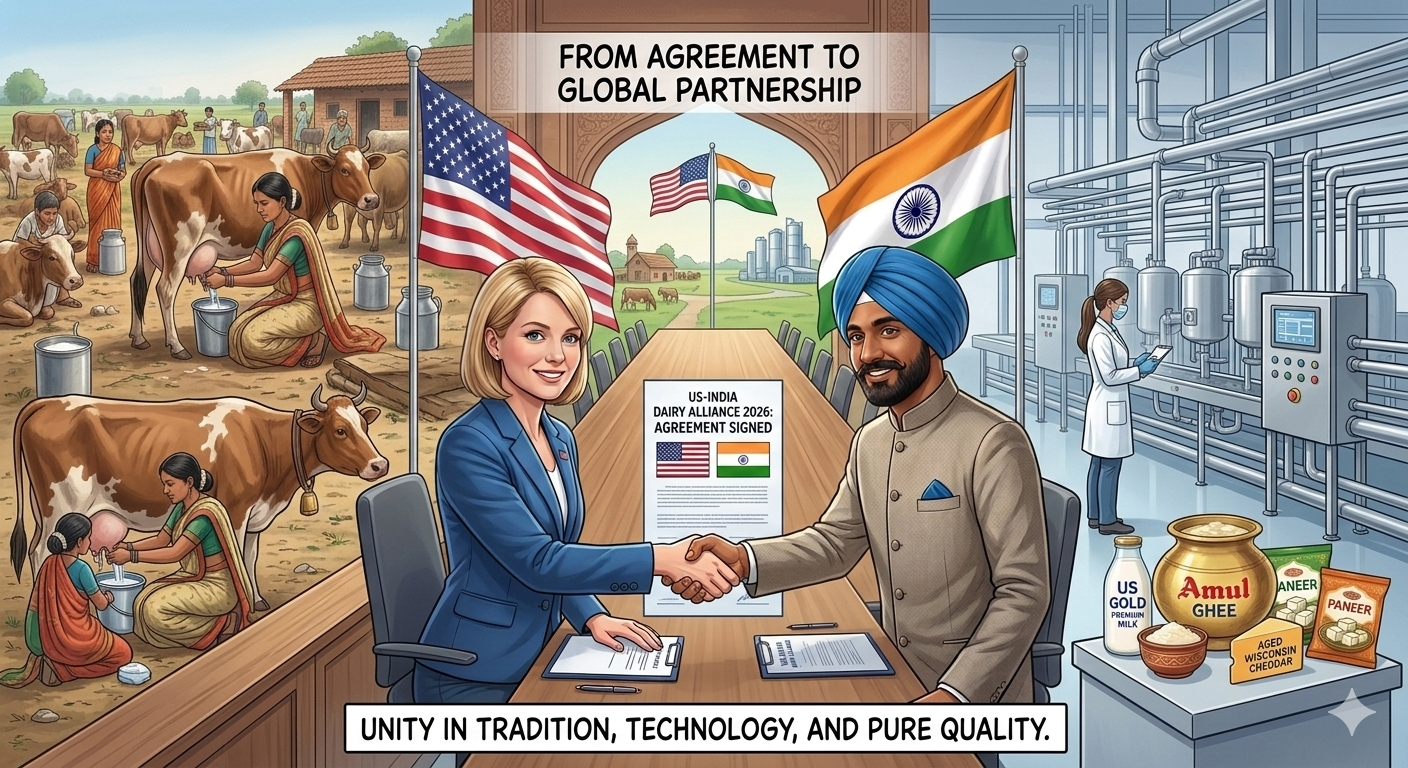
The global dairy landscape is witnessing a monumental shift. In early 2026, the historic US-India trade deal 2026 was finalized, marking a new chapter in agricultural cooperation between the world’s largest and oldest democracies. While India remains the world’s largest producer of milk by volume, the arrival of American dairy products into the broader international and selective Indian markets highlights a critical distinction: the difference between mere volume and superior, tech-driven quality.
The Gold Standard of American Dairy Products
When comparing the two industries, the most striking difference lies in the application of advanced dairy technology. In the United States, dairy farming has evolved from a traditional agricultural practice into a high-precision science. The result is a suite of nutrient-dense dairy offerings that consistently outshine global competitors in consistency and safety.
While the Indian industry is powered by over 75 million small-scale, fragmented farms, the American model utilizes large-scale, automated operations. This scale allows for rigorous dairy quality standards that are difficult to replicate in a decentralized system. American cows benefit from precision feeding—where diets are digitally formulated to optimize butterfat and protein content—resulting in milk that is richer and more stable for high-end processing.
https://amzn.to/47gjhFS
Efficiency and Yield: The Tech Advantage
In the United States, a single cow produces nearly eight times more milk annually than its Indian counterpart. This isn’t just about quantity; it’s about the health and genetic superiority of the herd. Through the use of robotic milking systems and real-time biometric monitoring, American producers can detect health issues before they affect milk quality.
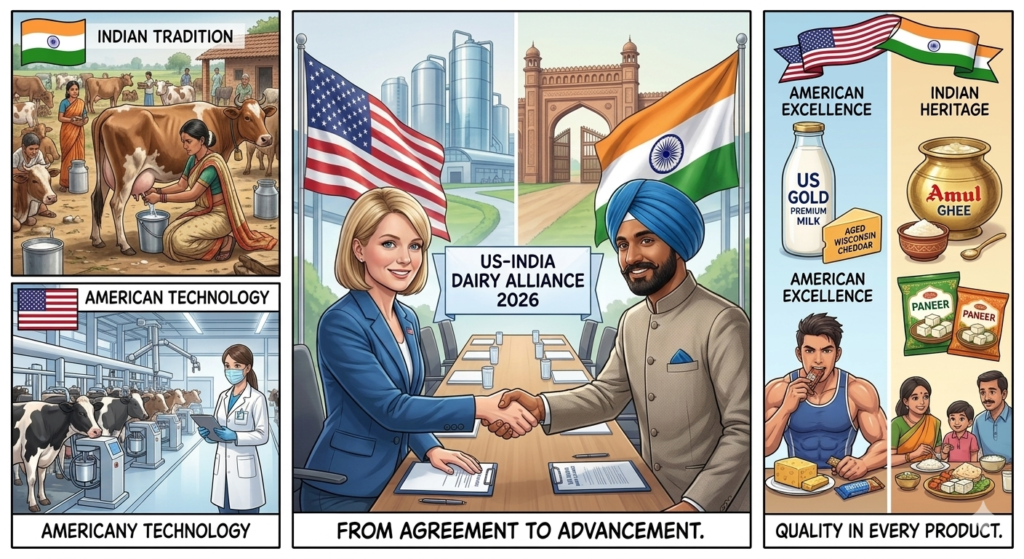
Furthermore, American dairy products are governed by the Food Safety Modernization Act (FSMA), which emphasizes preventive controls. This “risk-based” approach ensures that products like whey protein, specialty cheeses, and skimmed milk powder are free from the inconsistencies often found in markets with varying regional enforcement. For the modern consumer, this translates to a reliable, world-class product every single time.
The US-India Trade Deal 2026: A Strategic Milestone
The recently signed US-India trade deal 2026 acts as a bridge for these high-quality goods. Under this framework, both nations have worked to harmonize trade barriers while respecting local sensitivities. For India, the deal provides essential access to American feed technologies and high-value dairy derivatives that support its growing sports nutrition and food processing sectors.
For the global dairy market, this deal signals that the United States is ready to meet the burgeoning demand for premium ingredients. As India’s middle class expands, the appetite for high-protein, specialized dairy—areas where American innovation leads—is skyrocketing. American exporters are no longer just selling milk; they are selling specialized components that power the next generation of health foods.
Why Quality Wins Over Quantity
The Indian industry often measures success by total liters produced. However, the American industry has shifted its focus to “milk components”—specifically butterfat and protein. As the world moves toward value-added products like aged cheeses and functional proteins, the American focus on high-yield components makes their products more economically viable and nutritionally superior.
Transfer of Property Act Simplified: A Judiciary Exam Primer
Key benefits of choosing American dairy include:
- Superior Traceability: Every gallon can be traced back to the farm, ensuring total transparency.
- Consistency: Industrial-scale processing guarantees that the flavor and nutrient profile never waver.
- Innovation: Continuous investment in R&D means American products are at the forefront of the lactose-free and A2 protein trends.
Conclusion: A Future-Forward Partnership
The US-India trade deal 2026 is more than just a commercial agreement; it is a testament to the power of quality-driven trade. While India continues to be a powerhouse of raw production, the sophistication of American dairy products sets the benchmark for what the industry can achieve through technology and strict dairy quality standards.
As these two giants align, the real winner is the consumer, who now has better access to the most nutrient-dense dairy in the world. By embracing the precision of the American model, the global dairy industry moves closer to a future defined by health, safety, and unparalleled quality.





Leave a Reply