







Democracy is often defined by the “will of the people,” but as Nobel laureate Kenneth Arrow proved in his “Impossibility Theorem,” there is no mathematically perfect way to aggregate individual preferences into a single community-wide ranking. The “how” of voting determines the “who” of winning.
This blog explores the intricate machinery of global elections, blending historical evolution, philosophical foundations, and a comparative analysis of how India and the world cast their ballots.
🏛️ The Historical & Philosophical Pulse
The act of voting has evolved from the colored stones of Ancient Greece to the sophisticated digital encryptions of today. However, the 19th and 20th centuries were the true laboratory for modern systems, as thinkers grappled with the tension between stability and fairness.
The Thinkers’ Perspective
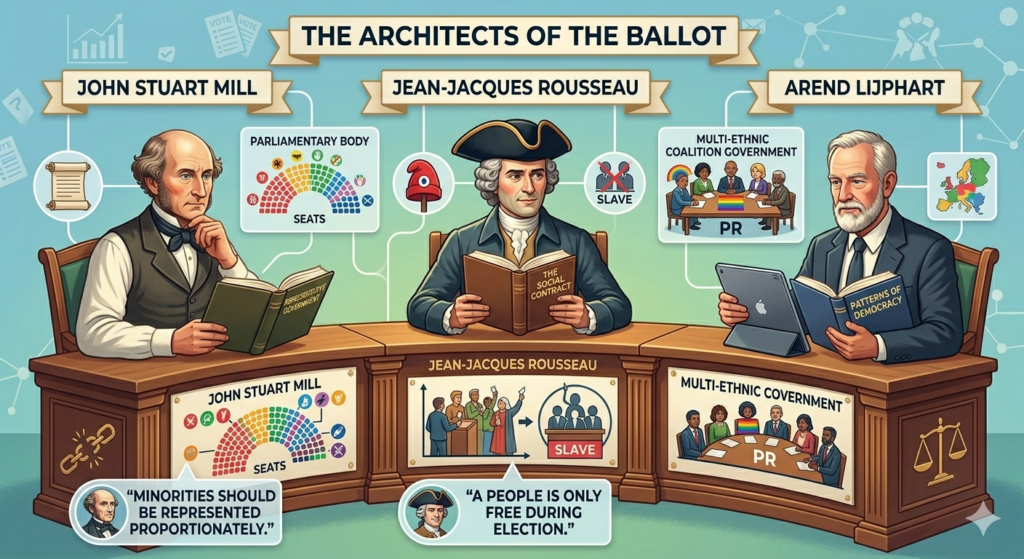
- John Stuart Mill (Considerations on Representative Government, 1861): Mill was a fierce critic of “class legislation” and advocated for proportional systems.“In a really equal democracy, every or any section would be represented, not disproportionately, but proportionately.”
- Jean-Jacques Rousseau (The Social Contract, 1762): Rousseau favored direct participation, famously quipping that the English people are only free during the election of members of parliament; as soon as they are elected, the people are “slaves.”
- Alexis de Tocqueville (Democracy in America, 1835): He warned of the “Tyranny of the Majority,” a critique often leveled at systems that ignore the voices of the 49% in favor of the 51%.
🗳️ Major Voting Systems: A Deep Dive
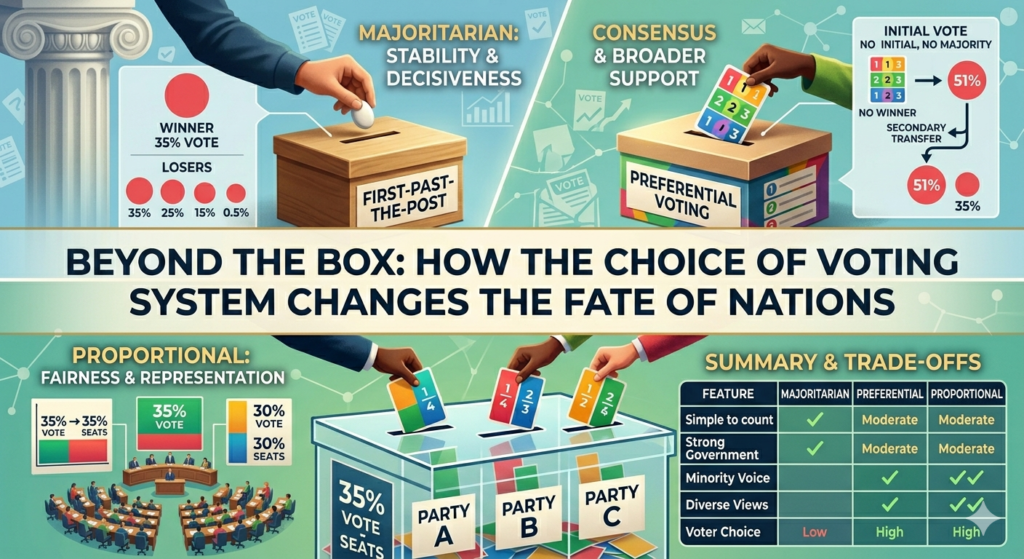
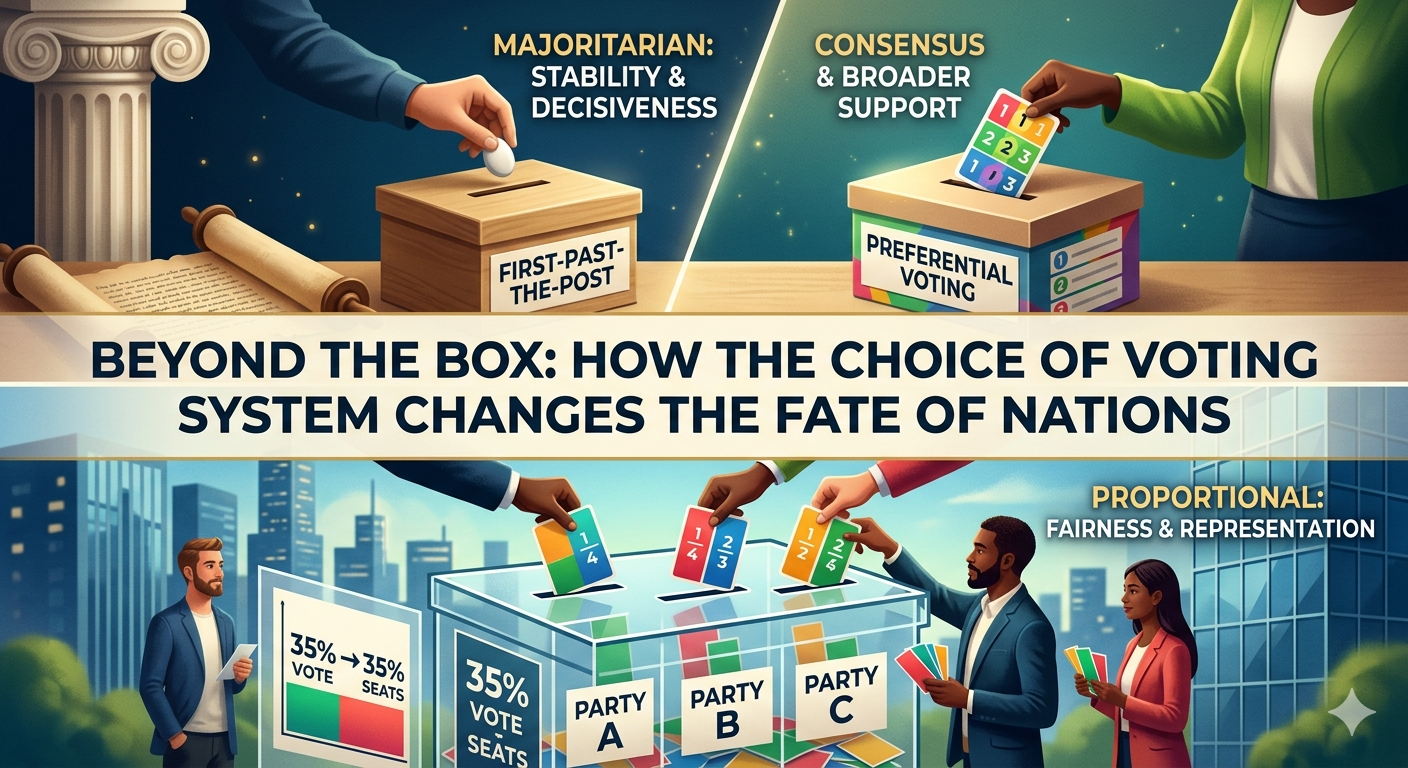
1. First-Past-The-Post (FPTP): The Speedster
Used in the Indian Lok Sabha, the UK, and the US, FPTP is the simplest form of plurality voting. The candidate with one more vote than the runner-up wins the seat.
- The Pro: It produces clear, decisive mandates and strong single-party governments.
- The Con: It leads to “Wasted Votes.” In the 2014 Indian General Elections, the BJP won a full majority (282 seats) with approximately 31% of the popular vote.
- Duverger’s Law: Political scientist Maurice Duverger argued that FPTP naturally trends toward a two-party system, as voters fear “wasting” their vote on third parties.
2. Preferential Voting: The Negotiator
In systems like Instant Runoff (AV) or Single Transferable Vote (STV), voters rank candidates (1, 2, 3…).
- India’s Higher Houses: While India uses FPTP for the “People’s House,” it uses PR-STV for the Rajya Sabha and the Presidential Election. This ensures that the President has a broad consensus across states and parties.
- Global Use: Australia (House of Representatives) and Ireland (STV).
- The Mechanism: If your #1 choice is eliminated, your vote isn’t “lost”—it transfers to your #2 choice.
3. Proportional Representation (PR): The Mirror
Popular in Germany and the Netherlands, PR ensures that a party’s seats in parliament match their share of the national vote.
- Mixed-Member Proportional (MMP): Used in Germany, this is a “best of both worlds” system. Voters get two votes: one for a local representative (FPTP) and one for a party list (PR).
https://hindkosh.press/product/1000-high-quality-quote-images/📊 Visualizing the Impact: A Comparative Infographic
The Spectrum of Representation
| System Type | Primary Goal | Key Example | Philosophy |
| Majoritarian (FPTP) | Stability | India (Lok Sabha) | “Winner takes all” |
| Preferential (STV) | Consensus | Australia / Ireland | “Broadest support wins” |
| Proportional (PR) | Fairness | Germany / Brazil | “Seats should match votes” |
⚖️ The Disproportionality Gap (Hypothetical FPTP Result)
Imagine a constituency with three parties. Under FPTP, the result often looks like this:
- Party A: 36% (Wins the seat)
- Party B: 34% (0 Representation)
- Party C: 30% (0 Representation)
- Outcome: 64% of voters are represented by someone they did not vote for.
⚖️ Comparative Analysis: Stability vs. Fairness
| Feature | FPTP (India/UK) | PR (Germany/Israel) | Preferential (Australia) |
| Simplicity | ⭐⭐⭐⭐ | ⭐⭐ | ⭐⭐⭐ |
| Govt. Stability | High (Single Party) | Moderate (Coalitions) | High |
| Minority Voice | Low (unless regional) | Very High | Moderate |
| Accountability | Clear (1 MP per area) | Diffuse (Party lists) | Clear |
The Indian Context
India chose FPTP in 1950 primarily for its simplicity. In a nation with high illiteracy at the time, ranking candidates (STV) was deemed too complex for general elections. However, as the democracy matures, debates often arise (notably in Law Commission Report No. 170) about introducing a hybrid system to better represent the diverse multi-party reality of India.
🏁 Final Thoughts
As Winston Churchill famously noted, “Democracy is the worst form of government, except for all those other forms that have been tried.” The “perfect” system does not exist. A country prioritizing decisive leadership will lean toward FPTP; a country prioritizing social inclusion and minority rights will choose PR. The future likely lies in Hybrid Systems, which attempt to marry local accountability with mathematical fairness.
Would you like me to create a detailed flowchart explaining how votes are transferred in the Indian Presidential Election?
📚 References
- Lijphart, A. (1999). Patterns of Democracy. Yale University Press.
- Mill, J.S. (1861). Considerations on Representative Government.
- Duverger, M. (1954). Political Parties.
- Constitution of India: Articles 54, 55 (Presidential) and 81 (Lok Sabha).
- Election Commission of India (ECI): Statistical Reports on General Elections.


Leave a Reply