









Introduction
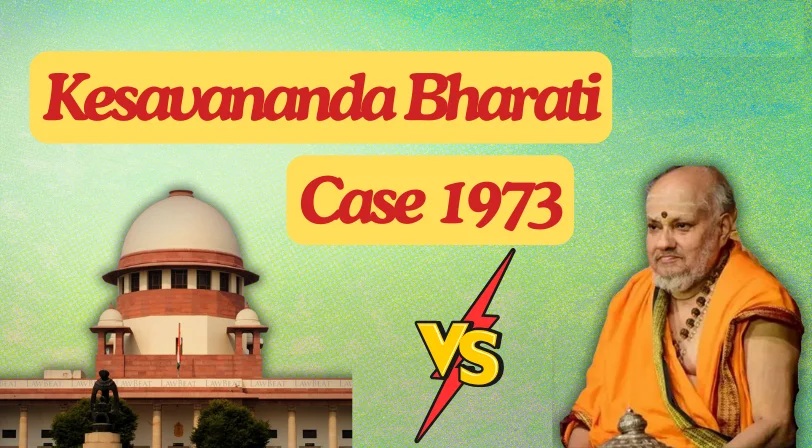
The Kesavananda Bharati v. State of Kerala (1973) case is one of the most celebrated constitutional law judgments in India. It laid down the Basic Structure Doctrine, which restricts Parliament’s power to amend the Constitution. Often called the “Constitution’s North Star,” the doctrine balances parliamentary supremacy with judicial protection of fundamental rights.
This blog reviews the background, judgment, and impact of the case with references, examples, and reforms that shaped Indian democracy.
Background of the Case
The petitioner, Swami Kesavananda Bharati, was the head of the Edneer Mutt in Kerala. He challenged the Kerala Land Reforms Act, which sought to impose restrictions on the management of religious property. Though the immediate issue was property rights, the case soon became a constitutional milestone.
At stake was a larger question: Does Parliament have unlimited power under Article 368 to amend the Constitution, even to the point of altering fundamental rights?
This question had already seen conflicting rulings:
- Shankari Prasad (1951) and Sajjan Singh (1965): Parliament could amend fundamental rights.
- Golaknath v. State of Punjab (1967): Parliament could not amend fundamental rights.
The Kesavananda Bharati case was a response to this legal deadlock.
The Judgment: Birth of the Basic Structure Doctrine
Delivered on 24 April 1973, the judgment by a 13-judge bench (the largest in Indian judicial history) is famous for its 7:6 majority decision.
Key takeaways:
- Parliament can amend any part of the Constitution, including fundamental rights.
- However, Parliament cannot alter or destroy the “basic structure” of the Constitution.
Thus was born the Basic Structure Doctrine, which has no explicit mention in the Constitution but is judicially evolved.
FILL THIS FOR FOR MORE SUCH CONTENT:
What Constitutes the Basic Structure?
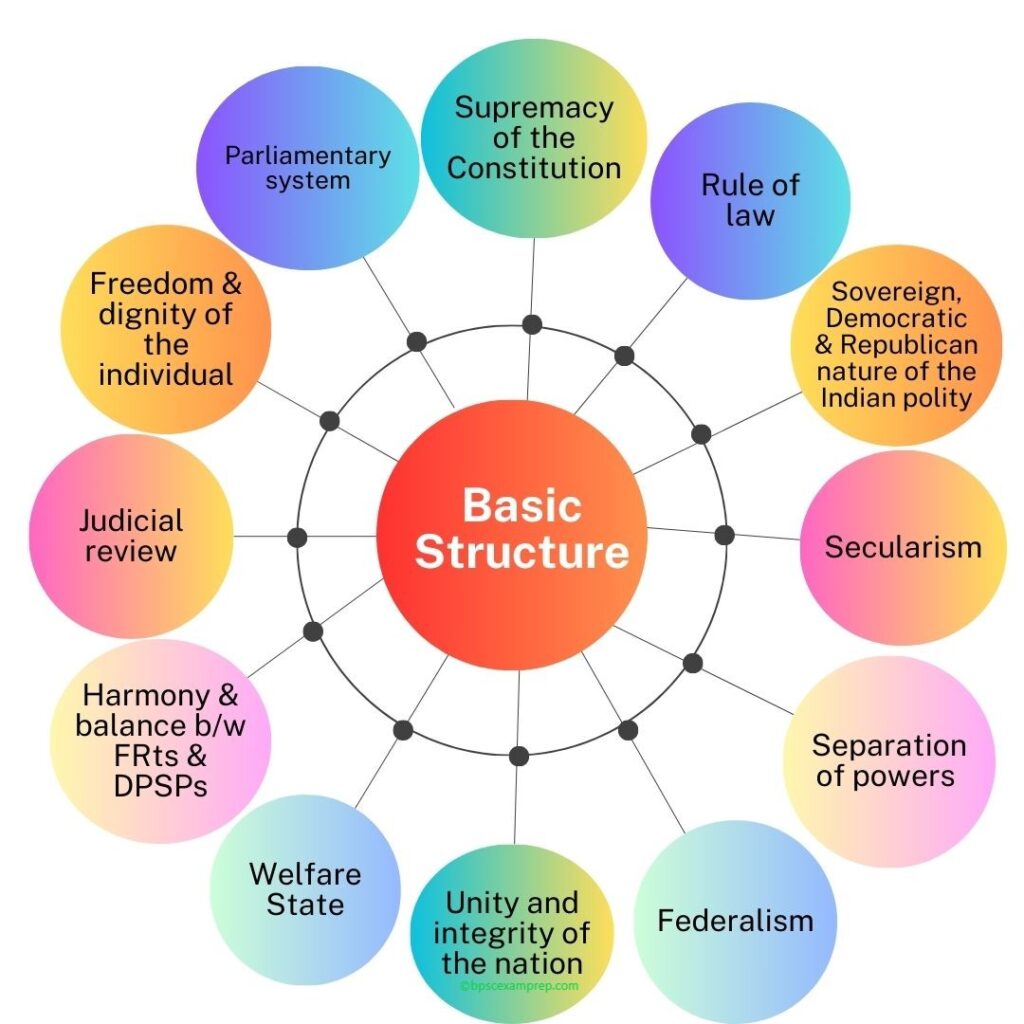
The Court did not give an exhaustive list but suggested some core principles:
- Supremacy of the Constitution
- Rule of law
- Separation of powers
- Judicial review
- Federalism
- Secularism
- Democratic form of government
- Fundamental rights
Subsequent cases like Indira Gandhi v. Raj Narain (1975) and Minerva Mills v. Union of India (1980) expanded the list.
“The Constitution is not a mere lawyers’ document, it is a vehicle of life.”
Dr. B.R. Ambedkar
Impact of Kesavananda Bharati Case on Indian Democracy
The doctrine has been a guardian of democracy. Examples:
- Indira Gandhi v. Raj Narain (1975): The Supreme Court struck down an amendment that attempted to immunize the Prime Minister’s election from judicial review.
- Minerva Mills (1980): Reinforced that limited amending power itself is part of the basic structure.
- NJAC Case (2015): Struck down the National Judicial Appointments Commission for violating judicial independence.
These cases prove how the doctrine serves as a constitutional safeguard against authoritarianism.
CLICK HERE FOR MORE SUCH CONTENT : https://hindkosh.blog/
Criticism of the Doctrine
While celebrated, the doctrine faces criticisms:
- Judicial Overreach: Critics argue judges “created” the doctrine without explicit constitutional text.
- Uncertainty: No final list of “basic features” exists, leaving it to courts’ interpretation.
- Parliamentary Supremacy Concerns: Some view it as undermining the will of elected representatives.
Yet, despite criticism, it remains a cornerstone of constitutional law.
Conclusion
The Kesavananda Bharati v. State of Kerala case is not merely about property rights or land reforms. It represents the soul of the Indian Constitution. The Basic Structure Doctrine ensures that while Parliament has wide powers to amend, it cannot dismantle the essential features of democracy.
This doctrine continues to guide the judiciary whenever constitutional amendments are challenged, keeping alive the spirit of constitutionalism. It stands as a reminder that India’s Constitution is both flexible and eternal — adapting to change without losing its identity.





Leave a Reply